

Ductile Iron Pipe for Municipal Water Distribution Networks: Sizing, Pressure Classes, and Joints
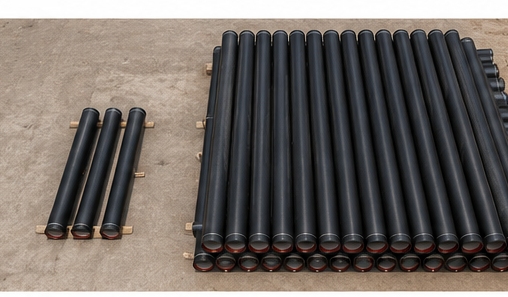
Municipal water distribution is where ductile iron pipe (DIP) earns its place in most city networks. From the treatment outlet to the street main and the service connection, distribution carries steady pressure, tolerates surge from pumps and valves, and stays repairable for decades underground.
Why distribution networks favour DIP
Distribution favours DIP because it balances three things buyers care about: pressure capacity, joint reliability, and long-term maintainability. Unlike plain steel it does not rust through in wet ground, and unlike PVC it carries surge and impact without brittle failure.
Sizing the network from demand, not catalogue
Sizing starts from peak demand and an allowable velocity, not from a diameter someone used last time. Designers fix the required flow, pick a velocity band (commonly 0.6–2.0 m/s for distribution), and solve for bore; the residual head at the farthest point then sets the pressure class. The hydraulic performance note explains why bore smoothness and the Hazen-Williams C value affect pumping energy across a network's whole life.
Pressure class from surge, not just static head
Pressure class is set from worst-case surge, not only the static head at the highest point. A pump trip or a fast valve closure can briefly double the local pressure, and the pipe, joints, and thrust restraint must absorb it without leaking. The water-hammer guide shows how class and surge are fixed together before the BOQ is issued — which is why specifying only to static head under-designs the line.
Joints: T-type push-on, deflection, and trenchless
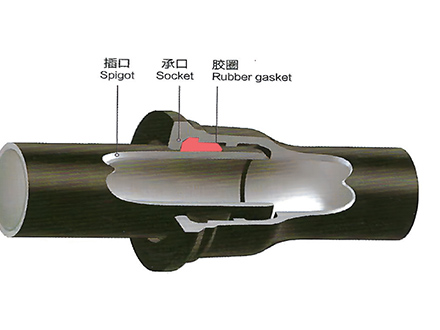
Most distribution mains use T-type push-on joints: fast to assemble, sealed by a rubber gasket, and able to deflect a few degrees to follow trench alignment. The joints and connections page covers where push-on, mechanical, and flanged joints each belong, and the flexible joint deflection guide shows the angles that let a main bend without special fittings. For crossings under roads the same joint flexibility supports trenchless methods without bespoke couplings.
Lining: protecting the metal and the water
Inside, distribution pipe carries potable water, so the lining protects both the wall and the supply. Cement mortar lining is the default for potable duty; epoxy or polyurethane linings are specified where aggressive water or specific hygiene rules call for them. The coating and lining page explains how the internal lining is selected together with the external protection, not as separate decisions.
External protection matched to the soil
Outside, the buried main meets the soil, and that is where many distribution failures actually begin. In benign ground a standard zinc + bitumen system is enough; in saline, acidic, or wet soil a polyethylene sleeve or upgraded coating is the safer call.
Standards and the document file
Distribution specifications are written to ISO 2531, EN 545, EN 598, or AWWA C151 depending on the utility and the region; the standards and certification page ties the product norm to the conformity evidence buyers expect. The tender specification guide shows how to write the standard and lining so bids stay comparable, and the supplier document checklist keeps the certificate file that proves what was actually delivered.
Buyer's checklist for a distribution package
Before issuing a distribution package, confirm: (1) diameters and pressure class derived from surge, not static head, (2) joint type and allowable deflection for the trench, (3) internal lining matched to potable duty, (4) external protection matched to the soil, (5) the product standard named explicitly in the spec, and (6) the document and inspection file the delivery needs. Writing these into the bid stops a low price from hiding a main that cannot carry the duty or clear the site.
Inquire about specifications and pricing →
Frequently asked questions
What diameter range is typical for municipal distribution?
Distribution mains commonly run from DN80 up to around DN600 for street and trunk networks, with larger sizes reserved for transmission feeders. The bore is solved from peak demand and an allowable velocity band, not chosen from a catalogue.
How is pressure class determined for a water main?
Pressure class is set from worst-case surge, not just the static head at the highest point. A pump trip or fast valve closure can briefly double local pressure, and the pipe and joints must absorb it.
Which joint type is used for distribution mains?
Most distribution mains use T-type push-on joints, sealed by a rubber gasket and assembled without bolts. They deflect a few degrees to follow trench alignment and speed up laying. The joints page and the deflection guide cover where push-on, mechanical, and flanged joints each belong.
What lining is required for potable water distribution?
Cement mortar lining is the default for potable duty because it protects the metal and is accepted for drinking water. Epoxy or polyurethane linings are specified where aggressive water chemistry or local rules call for them. The coating and lining page explains how the internal lining is paired with the external protection.
Which product standard should a distribution specification name?
Distribution specs are written to ISO 2531, EN 545, EN 598, or AWWA C151 depending on the utility and region. Naming the standard explicitly avoids the "equivalent" wording that lets non-compliant pipe into a bid.
Tiegu is a China-based ductile iron pipe sourcing and export partner serving international water infrastructure, wastewater, and industrial projects.
We supply DN80–DN2600 ductile iron pipes and fittings manufactured according to ISO 2531, EN 545, EN 598, and AWWA standards, with cement mortar lining, epoxy lining, and various external coating options.
From technical specification confirmation and supplier coordination to quality inspection, export documentation, and logistics support, Tiegu provides a reliable one-stop sourcing solution under a single commercial contract.
 GT-type Joint Ductile Iron Pipe
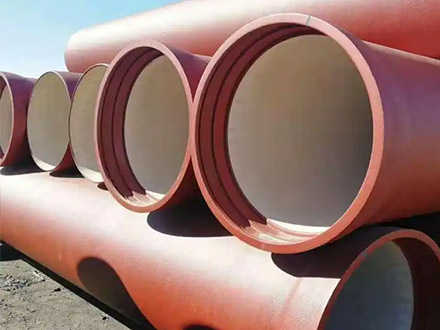
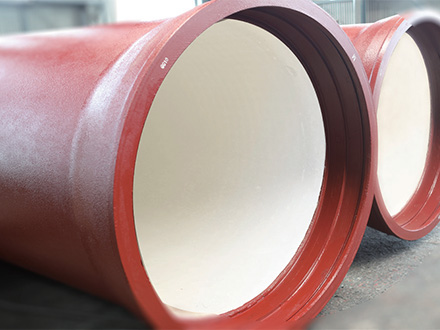 Sewage Pipe (Ductile Iron Sewage Pipe)
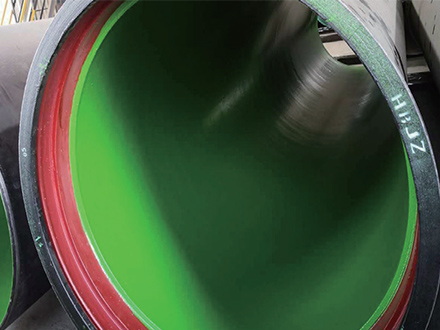 Special Coating Pipe (Ductile Iron Pipe with Special Coatings)