

Self-Restrained vs. Standard Joints in Ductile Iron Pipes: What Is the Real Difference?
Self-Restrained vs. Standard Joints in Ductile Iron Pipes: What Is the Real Difference?
When designing a pressurized water pipeline, engineers often face a key decision:
Should we use a self-restrained joint or a standard push-on joint with thrust blocks?
Both joint types are widely used in ductile iron pipe systems. However, their structural principles, cost implications, and suitability for specific working conditions differ significantly.
This article explains:
How self-restrained joints prevent pipe separation
Whether they can reduce or eliminate thrust blocks
The cost vs. safety trade-off
Which solution performs better in slope and high-pressure applications
For a complete overview of ductile iron pipe joint types, refer to:
👉 Ductile Iron Pipe Joints & Connections
What Is a Standard Joint in Ductile Iron Pipes?
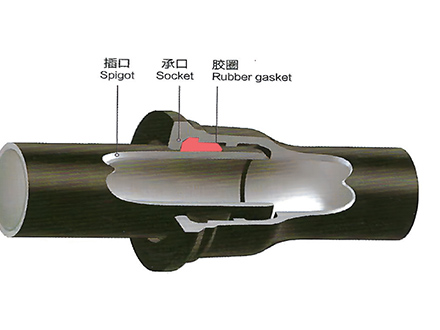
A standard joint (typically a push-on or T-type joint) relies on:
Rubber gasket sealing
Friction and joint geometry for positioning
External thrust blocks to resist axial forces
How does it work?
The gasket ensures watertight sealing, but it does not provide axial restraint.
When internal pressure generates thrust forces (especially at bends, tees, or reducers), concrete thrust blocks are typically required.
What Is a Self-Restrained Joint?
A self-restrained joint is designed with a mechanical locking structure that prevents axial pipe movement.
Depending on the design, it may include:
Locking segments
Metal teeth or rings
Boltless internal restraint systems
How does a self-restrained joint prevent separation?
When internal pressure generates axial force:
The locking mechanism transfers force between pipes
Axial movement is mechanically restricted
The joint resists pull-out without relying on external concrete blocks
In simple terms, the restraint is built into the joint itself.
Can Self-Restrained Joints Reduce or Eliminate Thrust Blocks?
This is one of the most common questions from project designers.
In many cases, yes.
Self-restrained joints can:
Reduce the need for concrete thrust blocks
Minimize excavation volume
Simplify installation in confined areas
However, complete elimination depends on:
Pipeline pressure class
Soil bearing capacity
Project design standards
Local engineering codes
Engineering verification is always required.
Cost vs. Safety: Which Option Is More Economical?
At first glance, self-restrained joints have:
Higher material cost per pipe
More complex manufacturing
Standard joints are typically cheaper per unit — but require:
Concrete thrust blocks
Additional labor
Longer curing time
Larger trench space
In long straight pipelines:
Standard joints with properly designed thrust blocks may be more economical.
In complex terrain or restricted spaces:
Self-restrained joints often reduce total project cost by simplifying installation.
The decision should be based on total installed cost, not pipe price alone.
Which Joint Performs Better on Slopes?
Slope installations create natural axial forces due to gravity and internal pressure.
With standard joints:
Thrust blocks are mandatory
Soil conditions become critical
Installation precision is important
With self-restrained joints:
Axial forces are distributed along the restrained section
Reduced reliance on soil stability
Higher safety margin against sliding
For steep slopes, self-restrained systems are often preferred.
Which Joint Is Safer for High-Pressure Pipelines?
High internal pressure increases axial thrust at:
Bends
Tees
Dead ends
Elevation changes
Standard joints:
Require well-designed thrust blocks to counteract these forces.
Self-restrained joints:
Mechanically resist axial forces along the restrained pipeline section.
In high-pressure transmission lines, restrained joints can improve system reliability — especially where soil conditions are uncertain.
When Should You Choose a Self-Restrained Joint?
Consider self-restrained joints when:
The pipeline is installed on slopes
Soil bearing capacity is unstable
Construction space is limited
High internal pressure is expected
Reducing concrete work is beneficial
When Are Standard Joints Still a Good Option?
Standard joints remain practical when:
Soil conditions are stable
Thrust blocks can be constructed easily
Pipeline pressure is moderate
Project budget is highly cost-sensitive
There is no universal solution — only the right choice for the working conditions.
Final Engineering Perspective
Standard joints rely on external restraint.
Self-restrained joints integrate restraint into the connection itself.
The optimal choice depends on pressure, terrain, soil, and total installation cost.
For a broader technical reference on ductile iron pipe joint types and connection systems, visit:
👉 http://www.ductileironpipe2600.com/index.php?c=category&id=29
 GT-type Joint Ductile Iron Pipe
 Sewage Pipe (Ductile Iron Sewage Pipe)
 Special Coating Pipe (Ductile Iron Pipe with Special Coatings)