

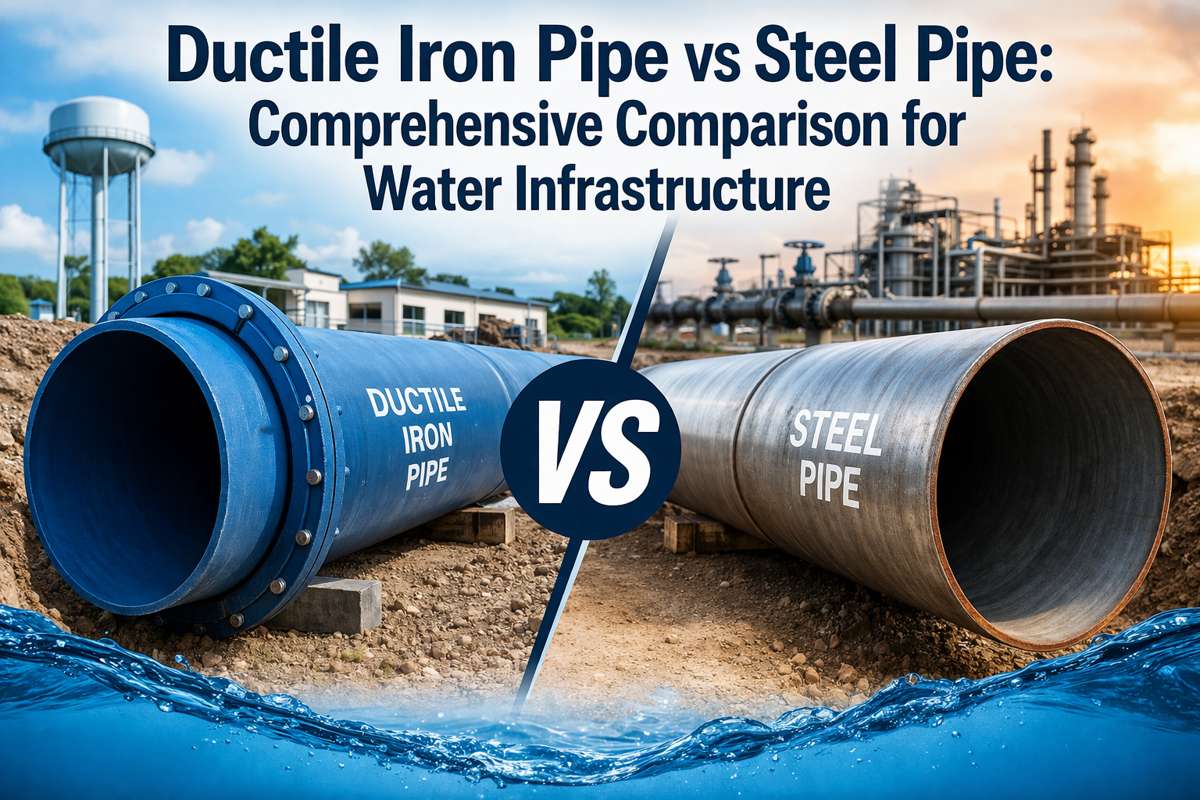
Ductile Iron Pipe vs Steel Pipe: Comprehensive Comparison for Water Infrastructure
Ductile Iron Pipe vs Steel Pipe: Comprehensive Comparison for Water Infrastructure
Selecting between ductile iron pipe and steel pipe is one of the most critical decisions in water infrastructure projects. Both materials have distinct advantages, limitations, and optimal application ranges. Ductile iron offers superior corrosion resistance and lower lifecycle cost for municipal water distribution. Steel provides higher strength-to-weight ratio and is preferred for high-pressure transmission and large diameters. This comprehensive comparison analyzes material properties, cost, installation, maintenance, and lifecycle performance to support informed decision-making.
Quick Summary: For DN80-600 municipal water distribution, ductile iron is typically 20-30% lower lifecycle cost with 50-100 year service life. For DN700+ high-pressure transmission, steel becomes competitive. Corrosion protection is critical for both materials in aggressive soils.
Material Properties Comparison
Mechanical Properties
| Property | Ductile Iron (GGG40/GGG50) | Steel (API 5L Gr.B/X42) | Advantage |
|---|---|---|---|
| Tensile Strength | 400-500 MPa | 415-520 MPa | Similar |
| Yield Strength | 250-300 MPa | 240-350 MPa | Similar |
| Elongation | 10-15% | 20-25% | Steel (more ductile) |
| Hardness (HB) | 160-220 | 140-180 | Ductile Iron (harder) |
| Modulus of Elasticity | 170 GPa | 210 GPa | Steel (stiffer) |
| Density | 7.1 g/cm³ | 7.85 g/cm³ | Ductile Iron (9% lighter) |
Corrosion Resistance
| Environment | Ductile Iron (with standard coating) | Steel (with standard coating) | Advantage |
|---|---|---|---|
| Neutral soil (pH 6-8) | Excellent (50-100 years) | Good (30-50 years) | Ductile Iron |
| Acidic soil (pH 4-6) | Good (20-40 years) | Fair (15-25 years) | Ductile Iron |
| Alkaline soil (pH 8-10) | Excellent (50+ years) | Good (30-40 years) | Ductile Iron |
| High chloride (>500 ppm) | Good (20-30 years) | Poor (10-20 years) | Ductile Iron |
| Stray current | Fair (requires protection) | Poor (requires protection) | Similar (both need CP) |
| Internal (water) | Excellent (cement lined) | Good (cement/epoxy lined) | Ductile Iron |
Key Insight: Ductile iron's graphite microstructure provides inherent corrosion resistance. Steel relies entirely on coatings and cathodic protection. In aggressive soils, ductile iron typically outlasts steel by 15-25 years with standard protection.
Cost Comparison
Material Cost (DN200-DN600)
| DN | Ductile Iron ($/m) | Steel ($/m) | Difference |
|---|---|---|---|
| DN200 | $85-95 | $70-80 | Steel 15% cheaper |
| DN300 | $140-160 | $120-140 | Steel 12% cheaper |
| DN400 | $220-250 | $200-230 | Steel 8% cheaper |
| DN500 | $340-380 | $330-370 | Similar |
| DN600 | $480-540 | $500-560 | Ductile Iron 4% cheaper |
Observation: Steel is cheaper for small diameters (DN200-400) due to lower material cost. Ductile iron becomes competitive at DN600+ due to thicker wall requirements for steel.
Installation Cost Comparison (DN400 Example)
| Cost Component | Ductile Iron | Steel | Difference |
|---|---|---|---|
| Pipe material (per meter) | $235 | $215 | Steel 8% cheaper |
| Joints/Fittings (per joint) | $180 (push-on) | $350 (welded) | DI 49% cheaper |
| Jointing labor (per joint) | $80 (15 min) | $250 (60 min welding) | DI 68% cheaper |
| Coating (external, per m²) | $8 (standard) | $15 (3LPE required) | DI 47% cheaper |
| Cathodic protection | Optional | Mandatory | DI saves $5,000-10,000/km |
| Equipment (welding machine) | Not required | $500-1000/day rental | DI saves cost |
Total Installed Cost (DN400, 1km Pipeline)
| Cost Category | Ductile Iron | Steel | Difference |
|---|---|---|---|
| Pipe material (167 joints × 6m) | $39,245 | $35,905 | Steel 8% cheaper |
| Joints/Fittings | $30,060 | $58,450 | DI 49% cheaper |
| Jointing labor | $13,360 | $41,750 | DI 68% cheaper |
| External coating | $6,700 | $12,400 | DI 46% cheaper |
| Cathodic protection | $0 (optional) | $8,000 | DI 100% cheaper |
| Total Installed Cost | $89,365 | $156,505 | DI 43% cheaper |
Winner: Despite higher material cost, ductile iron has 43% lower total installed cost for DN400 due to faster installation, simpler jointing, and reduced corrosion protection requirements.
Lifecycle Cost Analysis (50 Years)
Maintenance and Replacement Costs
| Cost Category | Ductile Iron | Steel | Notes |
|---|---|---|---|
| Annual inspection | $500/km | $800/km | Steel requires CP monitoring |
| Cathodic protection maintenance | $0 | $1,200/km/year | Rectifier, anode replacement |
| Coating repair (year 20) | $2,000/km | $8,000/km | Steel requires more extensive repair |
| Leak repair (50 years) | $5,000/km | $12,000/km | Steel more prone to corrosion leaks |
| Replacement (year 50) | $0 (still in service) | $80,000/km | Steel may need replacement at 40-50 years |
Net Present Value (50 Years, 5% Discount Rate)
| Cost Component | Ductile Iron (NPV) | Steel (NPV) |
|---|---|---|
| Initial installation | $89,365 | $156,505 |
| Maintenance (50 years) | $27,500 | $71,000 |
| Replacement (year 50) | $0 | $7,000 (discounted) |
| Total Lifecycle Cost (NPV) | $116,865 | $234,505 |
Lifecycle Cost Winner: Ductile iron has 50% lower lifecycle cost over 50 years. Higher initial savings plus lower maintenance make DI the economical choice for municipal water distribution.
Installation Comparison
Jointing Methods
| Aspect | Ductile Iron | Steel |
|---|---|---|
| Primary method | Push-on joint (TYTON) | Welding (butt/fillet) |
| Joint time | 10-15 minutes | 45-60 minutes |
| Skill requirement | Low (trained labor) | High (certified welder) |
| Equipment | None (manual) | Welding machine, generator |
| Hot work permit | Not required | Required (fire risk) |
| Weather sensitivity | Low (works in rain) | High (no welding in rain) |
| Joint flexibility | 3-5° deflection | Rigid (no deflection) |
Installation Speed
| Pipe Size | Ductile Iron (m/day) | Steel (m/day) | Speed Advantage |
|---|---|---|---|
| DN200 | 180-220 | 80-100 | DI 2.2× faster |
| DN300 | 150-180 | 60-80 | DI 2.3× faster |
| DN400 | 120-150 | 50-60 | DI 2.5× faster |
| DN500 | 100-120 | 40-50 | DI 2.4× faster |
| DN600 | 80-100 | 35-45 | DI 2.3× faster |
Field Observation: Ductile iron installation is 2-2.5× faster than steel for DN200-600. This translates to 50-60% lower labor cost and faster project completion.
Application Recommendations
Ductile Iron Preferred Applications
| Application | Diameter Range | Pressure Range | Reason |
|---|---|---|---|
| Municipal water distribution | DN80-600 | PN10-16 | Lower lifecycle cost, corrosion resistance |
| Sewer force mains | DN100-500 | PN10-16 | Internal corrosion resistance |
| Fire protection (underground) | DN100-300 | PN16 | Reliability, low maintenance |
| Irrigation systems | DN100-400 | PN10-16 | Cost-effective, durable |
| Industrial water (non-aggressive) | DN150-600 | PN10-25 | Standard solution |
Steel Preferred Applications
| Application | Diameter Range | Pressure Range | Reason |
|---|---|---|---|
| High-pressure transmission | DN400-1200 | PN25-40+ | Higher strength, thinner walls |
| Crossing (road/rail/river) | DN300-800 | Any | Can be installed by HDD, directional drilling |
| Offshore/submarine | DN300-1000 | High pressure | Flexible, can be spooled |
| Slurry pipelines | DN200-600 | High pressure | Abrasion resistance (with special lining) |
| Large diameter (>DN700) | DN700-2000 | PN10-25 | More economical at large sizes |
Corrosion Protection Requirements
Ductile Iron Protection
| Component | Standard Protection | Enhanced Protection |
|---|---|---|
| External | Zinc coating (130g/m²) + bitumen paint | PE sleeving (2mm) or PU coating |
| Internal | Cement mortar lining (5-9mm) | Epoxy lining (for aggressive water) |
| Joints | Bitumen paint after assembly | Heat-shrink sleeves |
| Cathodic protection | Optional (aggressive soils only) | Sacrificial anodes or impressed current |
Steel Protection
| Component | Standard Protection | Enhanced Protection |
|---|---|---|
| External | 3LPE coating (3mm) | 3LPE + concrete weight coating |
| Internal | Cement mortar or epoxy lining | Double-layer epoxy |
| Joints | Heat-shrink sleeves (field joint) | Fusion-bonded epoxy (FBE) |
| Cathodic protection | Mandatory (impressed current) | Combined with coating |
Critical: Steel REQUIRES cathodic protection in most soils. Ductile iron can operate without CP in neutral soils (pH 6-8). This is a major cost and maintenance difference.
Environmental Impact
Carbon Footprint (per km DN400)
| Phase | Ductile Iron (kg CO₂) | Steel (kg CO₂) |
|---|---|---|
| Material production | 42,000 | 48,000 |
| Transportation | 3,500 | 4,200 |
| Installation | 1,800 | 3,500 |
| Maintenance (50 years) | 2,500 | 6,000 |
| Total (50 years) | 49,800 | 61,700 |
Conclusion: Ductile iron has 19% lower carbon footprint over 50 years due to lower maintenance requirements and longer service life.
Supply Chain Perspective
Material Selection for Project Requirements
Both ductile iron and steel pipes are widely available from Chinese manufacturers, but quality varies significantly. Some foundries specialize in ductile iron with proper spheroidization treatment; others focus on steel pipe with API certification. Tiegu integrates production capacity across qualified Chinese foundries, delivering compliant and high-quality casting products to buyers worldwide while matching material selection to project requirements, soil conditions, and budget constraints.
This ensures optimal material choice rather than one-size-fits-all approach.
Submit your project specifications, soil conditions, and pressure requirements to receive material recommendations and cost comparisons.
Selection Checklist
☐ Soil resistivity tested (>2000 ohm-cm = low corrosion risk)
☐ Soil pH measured (6-8 = neutral,<6>8 = alkaline)<!--6-->
☐ Chloride/sulfate content analyzed (>500 ppm = aggressive)
☐ Stray current survey conducted (near railways, DC transit)
☐ Pressure requirements confirmed (PN16 vs PN25+)
☐ Diameter optimized (DN<600 favors="" dn="">700 favors steel)<!--600-->
☐ Lifecycle cost calculated (50-year NPV comparison)
☐ Installation timeline considered (DI 2× faster)
Conclusion
For municipal water distribution (DN80-600, PN10-16), ductile iron pipe offers superior value: 43% lower installed cost, 50% lower lifecycle cost, 2× faster installation, and better corrosion resistance. Steel pipe is preferred for high-pressure transmission (PN25+), large diameters (DN700+), and special applications (crossings, offshore).
Key points:
Cost: DI has 43% lower installed cost, 50% lower lifecycle cost (50 years)
Corrosion: DI inherently more corrosion resistant; steel requires CP
Installation: DI is 2-2.5× faster due to push-on joints
Maintenance: DI requires less maintenance, no CP monitoring
Environment: DI has 19% lower carbon footprint
For most municipal water projects, ductile iron is the economical and technical choice. Steel should be reserved for applications where its unique advantages (high pressure, large diameter, flexibility) are required.
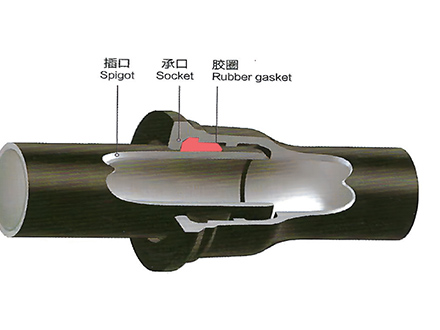 GT-type Joint Ductile Iron Pipe
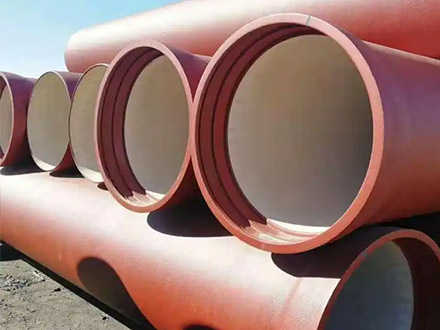
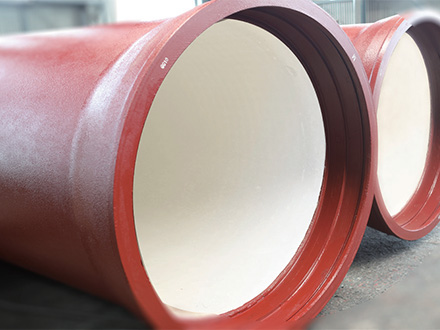 Sewage Pipe (Ductile Iron Sewage Pipe)
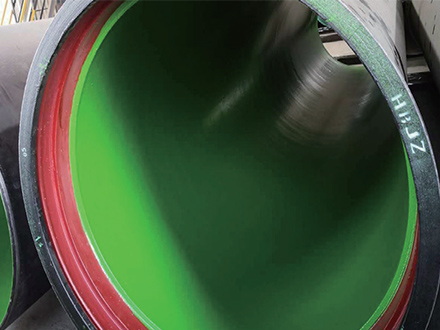 Special Coating Pipe (Ductile Iron Pipe with Special Coatings)