

Why Do Municipal Projects Prefer K9 Ductile Iron Pipes? Pressure & Lifespan Analysis

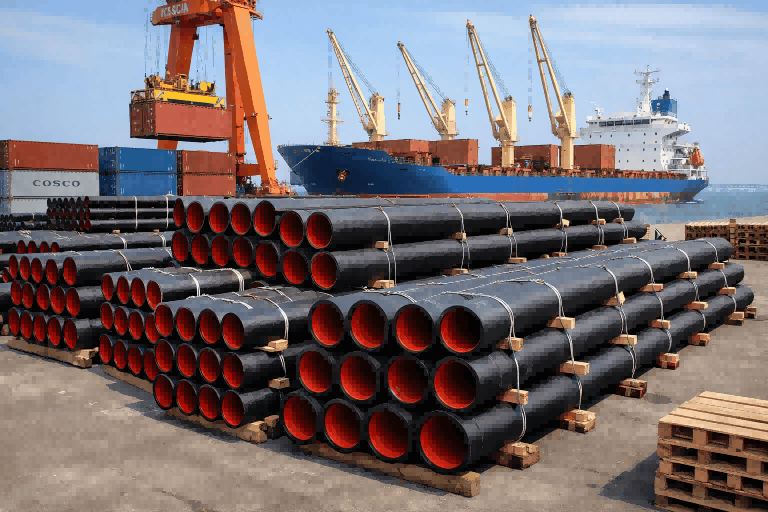
For a complete overview of South Africa water pipeline projects including material selection, standards, procurement, and logistics, see our South Africa Water Pipeline Complete Guide 2026 →
What Does "K9" Mean in Ductile Iron Pipe?
K9 is a pressure class designation defined in ISO 2531 (and its South African equivalent SANS 14394). The "K" designation refers to the wall thickness category, which directly determines the pipe's pressure handling capacity.
Under ISO 2531, K9 class ductile iron pipe is rated for:
Maximum Operating Pressure (MOP): 40 bar (PN40)
Pressure Maximum Admissible (PMA): 50 bar (includes 25% safety margin for surge/water hammer)
Minimum Wall Thickness: Varies by diameter — e.g., 6.4mm for DN100, 8.6mm for DN400, 12.1mm for DN1000
The K9 designation is the most widely specified pressure class for municipal water projects because it covers the vast majority of operating pressure scenarios — from low-pressure distribution networks (PN6-PN10) to high-pressure bulk transmission mains (PN25-PN40).
How Does K9 Pressure Performance Compare to Other Classes?
Understanding the pressure hierarchy helps engineers and contractors select the right class for each pipeline section, avoiding both under-specification (risk of failure) and over-specification (unnecessary cost).
| Pressure Class | MOP (bar) | PMA (bar) | Wall Thickness Increase vs K9 | Typical Application |
|---|---|---|---|---|
| K7 | 20 | 25 | -10% thinner | Low-pressure distribution, irrigation |
| K8 | 30 | 37.5 | -5% thinner | Medium-pressure water mains |
| K9 | 40 | 50 | Baseline (standard) | Standard municipal projects (most common) |
| K10 | 50 | 62.5 | +8% thicker | High-pressure transmission mains |
| K12 | 63 | 78.7 | +15% thicker | Special high-pressure / pumped schemes |
For most South African municipal water projects, K9 class provides adequate pressure capacity with optimal cost efficiency. K10 and K12 are reserved for specific high-pressure sections — typically near pumping stations or in high-elevation areas where static head combined with operating pressure exceeds 40 bar.
Real-World Pressure Scenarios in South African Municipal Systems
Understanding actual operating pressures helps justify K9 selection:
Urban distribution networks (Johannesburg, Durban, Cape Town): Operating pressures typically range from PN6-PN16 (6-16 bar). K9 (PN40) provides 2.5-6x safety margin for surge events.
Bulk transmission mains (Rand Water, Umgeni Water): Operating pressures range from PN16-PN30 (16-30 bar). K9 (PN40) provides 1.3-2.5x safety margin, sufficient for most surge scenarios.
High-elevation pumped schemes (Highveld region): Operating pressures can reach PN30-PN40 (30-40 bar). K9 (PN40 MOP) is adequate for steady-state operation; verify PMA (50 bar) against hydraulic surge analysis.
What Is the Actual Lifespan of K9 Ductile Iron Pipe?
Service life is the second critical factor — after pressure capacity — that makes K9 ductile iron pipe the preferred choice for municipal projects. Water infrastructure is typically designed for 50-100 year service life, and ductile iron pipe consistently delivers on this expectation when properly specified and installed.
Proven Service Life Data
Real-world performance data from municipal water authorities worldwide confirms:
Minimum expected service life: 50 years (conservative estimate for design purposes)
Typical service life: 70-100 years (based on actual replacement data from European and North American utilities)
Maximum recorded service life: 100+ years (many 19th-century cast iron pipes remain in service today)
The key to achieving this service life lies in the combination of internal and external protection systems specified in ISO 2531:
Internal Protection: Cement Mortar Lining (ISO 4179)
Cement mortar lining prevents internal corrosion, which is the primary degradation mechanism for water-carrying pipes. The alkaline environment created by cement mortar (pH 12-13) passivates the iron surface, preventing electrochemical corrosion reactions.
Cement mortar lining also maintains flow capacity over the pipe's service life. Unlike steel pipe (which experiences significant Hazen-Williams coefficient degradation over time due to internal corrosion), ductile iron pipe with cement lining maintains C = 140-150 throughout its service life, reducing pumping energy costs.
External Protection: Zinc Coating + Bitumen (ISO 8179)
The zinc coating (minimum 130g/m² per ISO 8179) provides cathodic protection — zinc sacrificially corrodes to protect the underlying iron, even if the coating is damaged during installation. In moderate soil conditions (resistivity >10,000 Ω·cm), zinc coating provides 35+ years of protection.
For aggressive soil conditions (resistivity <3,000 Ω·cm, high chloride or sulfate content), polyethylene encasement per ISO 12234 extends external protection beyond 100 years by creating a physical barrier between the pipe surface and corrosive soil elements.
Why Is K9 More Cost-Effective Than Alternatives?
Total cost of ownership analysis — including initial purchase cost, installation cost, maintenance cost, and replacement cost over 50 years — consistently favors K9 ductile iron pipe for municipal water applications:
| Cost Factor | K9 DI Pipe | HDPE Pipe (SDR 11) | PVC Pipe (PN16) | Steel Pipe |
|---|---|---|---|---|
| Initial Purchase | $$ | $$$ | $ | $$$ |
| Installation | $$ | $ | $ | $$$$ |
| Maintenance (50 years) | $ | $$ | $$$ | $$$$ |
| Service Life | 50-100 years | 30-50 years | 20-30 years | 30-50 years |
| Total Cost (50 years) | Lowest | Medium | High | Highest |
K9 ductile iron pipe delivers the lowest total cost of ownership because:
No replacement cost: 50-100 year service life eliminates the need for mid-life replacement required by PVC (20-30 years) and HDPE (30-50 years).
Minimal maintenance: Failure rates for properly installed ductile iron pipe are typically <0.1 failures/km/year, compared to 0.5-2.0 failures/km/year for aging PVC networks.
Flow capacity retention: Cement mortar lining maintains Hazen-Williams C = 140-150, reducing long-term pumping energy costs compared to corroded steel pipe (C = 80-100).
Common Problems in K9 Pipe Selection & How to Avoid Them
Engineer specifies K10 or K12 for applications where K9 is sufficient, adding 10-20% to pipe cost without meaningful performance benefit. Common in tender documents that use generic "K12 for all water mains" specifications.
Solution: Review hydraulic design report to confirm actual operating and surge pressures. Specify K9 for MOP ≤40 bar. Use K10/K12 only where hydraulic analysis confirms MOP >40 bar or surge pressure exceeds PMA of K9 (50 bar).
Engineer verifies steady-state operating pressure (e.g., PN25) and selects K9 (PN40 MOP), but fails to account for water hammer surge pressure (e.g., PN55), which exceeds K9's PMA rating (50 bar).
Solution: Always verify PMA (Pressure Maximum Admissible), not just MOP. If surge pressure exceeds 50 bar, specify K10 (PMA 62.5 bar) or install surge protection devices (surge tanks, air valves, variable speed drives).
Contractor specifies zinc + bitumen coating (standard per ISO 2531) without conducting soil resistivity testing. In aggressive soil, external corrosion causes pitting and failure within 10-15 years.
Solution: Conduct soil testing (resistivity, pH, chloride, sulfate) at 500m intervals along pipeline route. Specify epoxy coating + PE encasement for soil resistivity <3,000 Ω·cm or pH <6.5 / pH >8.5.
Supply Chain Alignment for Municipal Projects
Tiegu coordinates production with ISO 2531-certified foundries that regularly supply K9 ductile iron pipe for municipal water projects. We verify pressure testing records, cement lining thickness, and coating specifications before every shipment.
This means municipal engineers and EPC contractors receive K9 pipe with complete material test reports, third-party inspection certificates, and SABS compliance documentation — all managed through a single supply chain partner.
You can share your hydraulic design specifications or pipeline layout for K9 class verification and competitive quotation.
📋 Get Free Technical Quotation
Share your hydraulic design specifications — receive K9 verification and pricing within 24 hours
✅ Final Recommendation
For municipal water projects: K9 ductile iron pipe (PN40 MOP, PN50 PMA) is the optimal choice for 90% of municipal applications, delivering the best balance of pressure capacity, service life (50-100 years), and total cost of ownership.
Selection criteria:
✅ MOP ≤40 bar, surge pressure ≤50 bar: Specify K9 class (most cost-effective)
✅ MOP 40-50 bar, surge pressure ≤62.5 bar: Specify K10 class
✅ MOP >50 bar or special pumped schemes: Specify K12 class or install surge protection
Frequently Asked Questions
What is the difference between K9 and K12 ductile iron pipe?
K9 and K12 are pressure class designations per ISO 2531. K9 is rated for 40 bar maximum operating pressure (MOP) with 50 bar pressure maximum admissible (PMA). K12 is rated for 63 bar MOP with 78.7 bar PMA. K12 has approximately 15% thicker walls than K9, making it 15-20% more expensive. K9 is sufficient for 90% of municipal water applications; K12 is reserved for high-pressure transmission mains and special applications.
How long does K9 ductile iron pipe last underground?
K9 ductile iron pipe has a proven service life of 50-100+ years underground when properly specified and installed. The cement mortar lining (ISO 4179) prevents internal corrosion throughout the pipe's life. External zinc coating (ISO 8179) provides 35+ years of cathodic protection in moderate soils. Combined with polyethylene encasement (ISO 12234) in aggressive soils, K9 pipe can exceed 100 years of service life.
Is K9 ductile iron pipe suitable for high-pressure applications?
K9 ductile iron pipe handles up to 40 bar maximum operating pressure (MOP) with 50 bar pressure maximum admissible (PMA) for surge events. This is sufficient for most municipal water applications including bulk transmission mains (typically PN16-PN30 operating pressure). For applications exceeding 40 bar steady-state pressure, specify K10 (PN50 MOP) or K12 (PN63 MOP) class.
What is the wall thickness of K9 ductile iron pipe?
K9 wall thickness varies by diameter per ISO 2531 Table 1. Examples: DN100 = 6.4mm, DN200 = 6.6mm, DN300 = 7.2mm, DN400 = 8.6mm, DN600 = 10.2mm, DN800 = 11.4mm, DN1000 = 12.1mm, DN1200 = 13.0mm. Wall thickness increases with diameter to maintain consistent pressure capacity across the size range. Verify exact thickness per ISO 2531 table for your specific diameter.
📞 Contact Us for K9 Pipe Solutions
Tiegu — Professional Casting Export Partner
📱 WhatsApp / WeChat: +86 152 5613 5588
📧 Email: zbw@tiegu.net
🌐 Website: www.ductileironpipe2600.com
💬 Inquiry Form: Submit Your Requirements
Response Time: We typically respond within 24 hours with technical specifications, pricing, and delivery timelines for your project.
Related reading:
How to Choose a Reliable DI Pipe Supplier from China: A CompleteGuide
Summary: Key Takeaways
K9 ductile iron pipe (PN40 MOP, PN50 PMA) is the standard pressure class for 90% of municipal water projects, balancing pressure capacity with cost efficiency.
Service life of 50-100+ years makes K9 ductile iron pipe the lowest total cost of ownership option compared to HDPE, PVC, and steel alternatives.
Cement mortar lining (ISO 4179) prevents internal corrosion and maintains flow capacity; zinc coating (ISO 8179) + PE encasement (ISO 12234) prevents external corrosion.
Over-specifying pressure class (K10/K12 when K9 is sufficient) adds 10-20% to pipe cost without meaningful performance benefits.
Always verify PMA (not just MOP) against hydraulic surge analysis to ensure adequate safety margin for water hammer events.
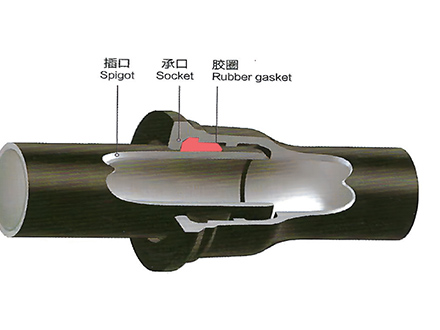 GT-type Joint Ductile Iron Pipe
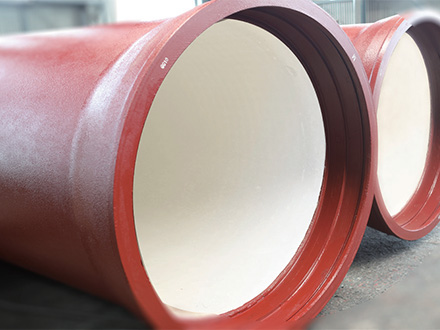 Sewage Pipe (Ductile Iron Sewage Pipe)
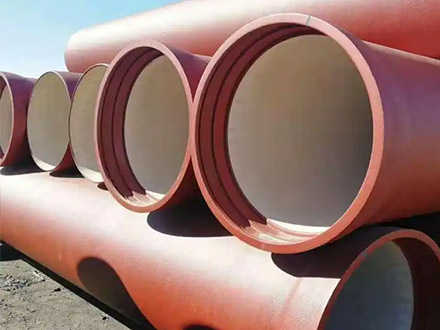
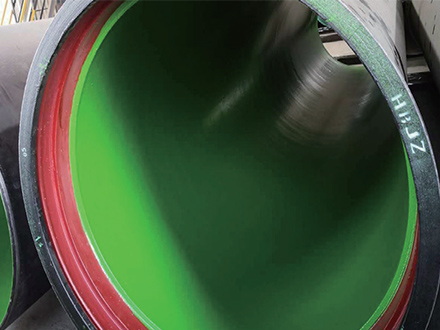 Special Coating Pipe (Ductile Iron Pipe with Special Coatings)